
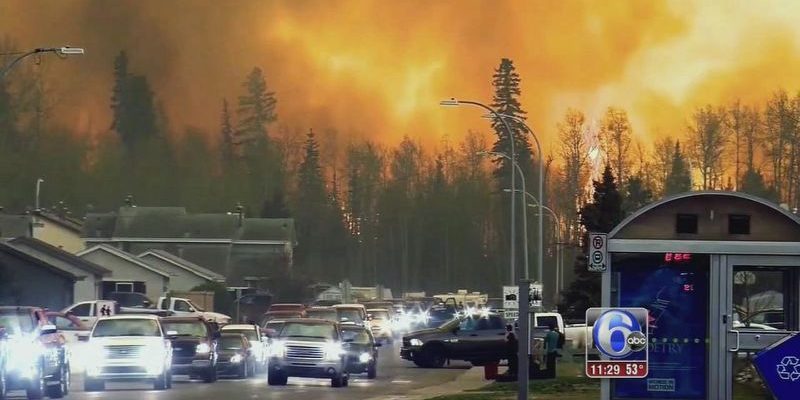
Evacuation
If You Get Trapped
Principles & Practices
WUI Culture
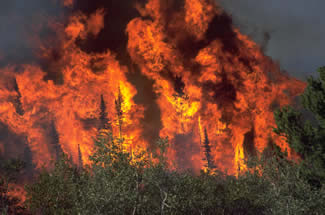
Wildfires are unpredictable and move very fast.
Wildfires are unpredictable, and even the best-laid plans can go amiss. If you find yourself trapped by a wildfire, you can take steps to increase your chances of survival. The roar of a wildfire can be extremely loud, and the house will get very hot and smoky as the fire front passes, so you must be emotionally prepared to deal with the horrific sound and strong natural urge to flee.
Choosing Your Shelter
The most important thing is to choose the place best able to withstand the flaming front of the fire. This may not be your home, but an outbuilding, shop, or even your car. The structure should have:
- A “Class-A” noncombustible roof.
- Noncombustible siding or at least 30-feet between the siding and vegetation.
- Eave areas and areas under decks boxed in, totally enclosed, and cleaned of flammable debris.
- 1/8-inch screens on attic, foundation, and eave vents.
- Dual-pane or tempered glass windows.
Inside Your Shelter

To survive you must STAY INSIDE until the fire passes.
To survive, YOU MUST STAY INSIDE THE SHELTER until the fire front passes. Although it will be very hot, it can be four or five times hotter outside.
- Close all windows and doors; place wet towels under door and window openings.
- Have your fire extinguishers out and ready to use.
- Fill sinks, tubs, and buckets with water for extinguishing any embers that enter the space as well as for drinking and flushing toilets.
- Plan for loss of power. Have flashlights and batteries ready.
- Disconnect electric garage door openers. Operate doors manually.
- Close metal window blinds. Remove flammable window treatments.
- Move furniture away from windows and sliding glass doors.
- Shut off attic fans, whole house fans, swamp coolers, and interior fans to keep smoke and ash from being drawn into the structure.
- Wet or remove swamp cooler pads to prevent them from catching on fire.
- Bring pets inside and place them in carriers.
- Put livestock and horses in an irrigated pasture or area where fuels have been removed.
- Leave exterior and interior lights on to help firefighters find your house in dense smoke.
- Stay in the center of the structure, away from windows and glass doors.
Wet down your surroundings.
Outside Your Shelter
- Strategically place sprinklers to wet your shelter and surroundings, and turn them on.
- Protect some hoses from flames and have them ready to use once the fire front has passed.
- Close exterior doors and windows, but leave them unlocked.
- Close or cover outside attic, eave, and basement vents to prevent embers from entering.
- Move all flammable materials at least 30-feet away from your shelter, including vehicles and recreational equipment, lawn furniture, and firewood.
- Plan for loss of power. Have emergency generators ready to power your well's pump.
- Store water for putting out burning embers or small fires after the fire front has passed.
- Shut off natural gas and propane.
- Open gates to prevent flames from spreading from a fence to your shelter.
Trapped in Your Vehicle
A structure will offer more protection than a car, so if there is a building nearby, get inside it. Otherwise, park and stay in your car. It will be safer than being in the open, where you would be directly exposed to flames and radiant heat.
- STAY IN THE VEHICLE.
- Find a safe place to park with little or no vegetation.
- Turn on headlights and emergency flashers to make your car more visible in heavy smoke.
- Close all windows and doors, shut off air vents, and turn off the air conditioner.
- Get under blankets or coats, preferably wool, and lie on the floor.
- Wait until the fire front passes and the outside temperature has dropped. Then get out and go to a safe area that has already burned.

Contact Us
Mike Ward, Executive Director
director@idahofirewise.org
PO Box 220
Kooskia, ID 83539
EIN 27-2535008
Our Partners