Terminology
Principles & Practices
WUI Culture
Access – The ability to gain entrance into an area with firefighting equipment.
Arson fire – A wildfire willfully ignited by anyone to burn, or spread to, vegetation or property without consent of the owner or his/her agent; also called incendiary fire.
Attack a fire – To limit the spread of fire by any appropriate means.
Authority Having Jurisdiction (AHJ) – The organization, office, or individual responsible for approving equipment, materials, an installation or a procedure for fire mitigation.
Brush – A collective term that refers to stands of vegetation dominated by shrubby, woody plants or low-growing trees–usually of a type undesirable for livestock or timber management.
Brush fire – A fire burning in vegetation that is predominantly shrubs, brush, and scrub growth.
Burning ban – A declared ban on open air burning within a specified area–usually due to sustained high fire danger.
Burning conditions – The state of the combined factors of the environment that affect fire behavior in a specified fuel type.
Burning period – The part of each 24-hour period when wildfires spread most rapidly; typically from 10 a.m. to sundown.
Canopy – The stratum containing the crowns of the tallest vegetation present (living or dead), usually above 20-feet.
Closure – Legal restriction, but not necessarily elimination, of specified activities such as smoking, camping or entry that might cause fires in a given area.
Combustible – Any material that will ignite and burn.
Community Wildfire Protection Plan (CWPP) – Address issues such as wildfire response, hazard mitigation, community preparedness or structure protection. The process of developing a CWPP can help communities clarify and refine their priorities for the protection of life, property and critical infrastructure in the wildland urban interface.
Condition of vegetation – Stage of growth or degree of flammability of vegetation that forms part of a fuel complex.
Conflagration – A raging, destructive fire. This term is often used to describe a fire burning under extreme fire weather. The term is also used when a wildland fire burns into a wildland urban interface that destroys many structures.
Creeping fire – A fire that burns with a low flame and spreads slowly.
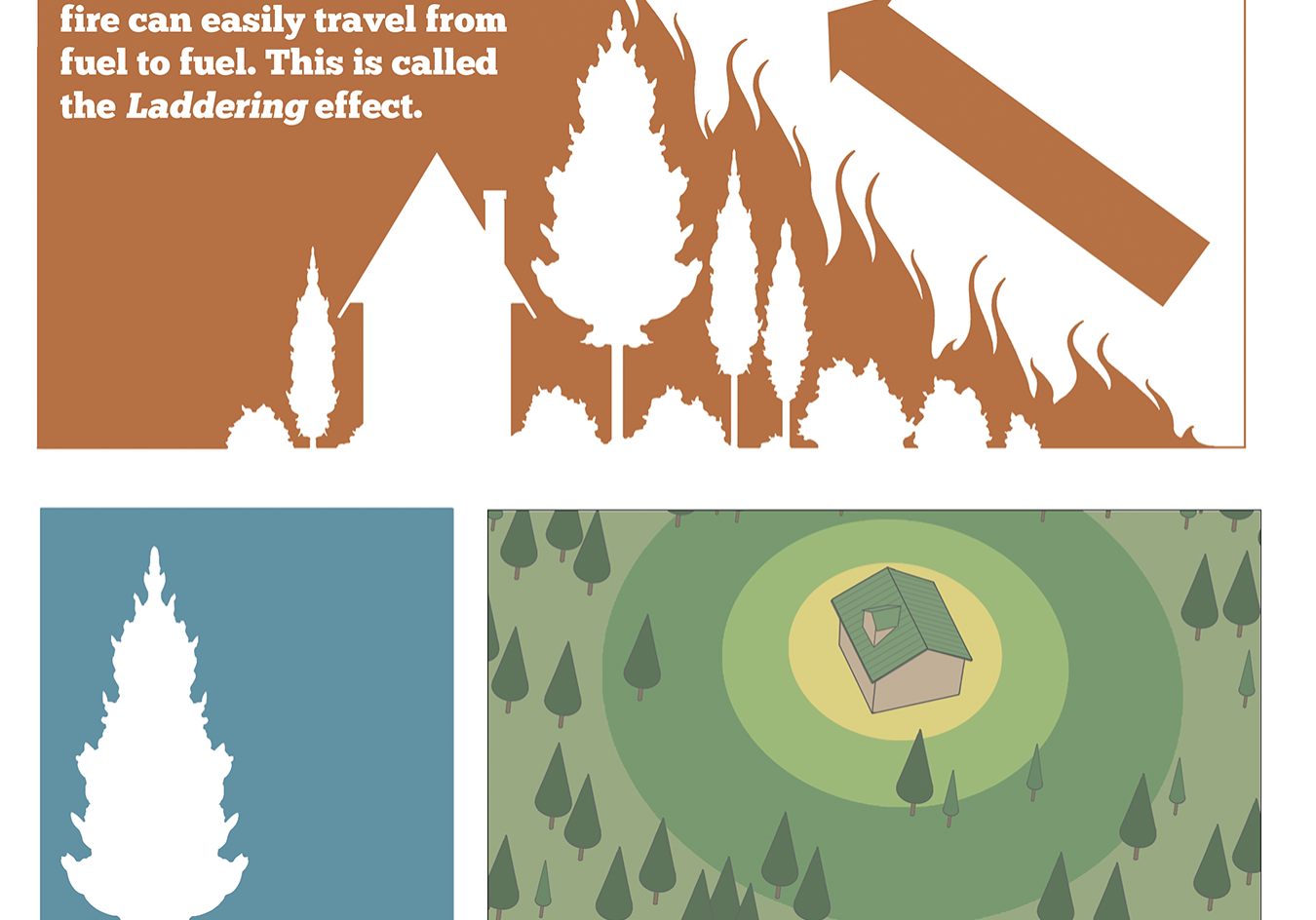
Crown fire – A fire that advances from top to top of trees or shrubs more or less independent of a surface fire.
Debris fire – In fire suppression, a fire spreading from any fire originally ignited to clear land or burn rubbish, garbage, crop stubble or meadows (excluding incendiary fires).
Defensible space – An area, typically a width of 30-feet or more, between an improved property and a potential wildfire where the combustibles have been removed or modified; recommended for maintaining a firewise home.
Drought – A long spell of very dry weather.
Drought Index – A number that represents the net effect of evaporation, transpiration and precipitation as a measure of cumulative moisture depletion in deep duff or upper soil layers.
Dry hydrant – An arrangement of pipe permanently connected to a water source other than a piped, pressurized water supply system that provides a ready means of water supply for firefighting purposes and that utilizes the suction capability of fire department pumpers.
Duff – The layer of decomposing organic materials lying below the litter layer of freshly fallen twigs, needles and leaves and immediately above the mineral soil.
Ecology – The relationships among living things and between living things and their environments.
Ecosystem – A stable level of organization and relationships within the living world that includes both the total array of biological organisms present in a defined area and the chemical-physical factors, of which wildland fire is included, that influence the plants and animals in it.
Embers – Hot, glowing pieces of fuel from a fire. Sometimes embers are airborne and can travel miles from the site of the fire.
Escape route – A pre-planned and clearly identified route of travel that firefighting personnel or evacuees are to take to access safety zones or other low risk areas.
Evacuation – The temporary movement of people and their possessions from locations threatened by wildfire or other disasters.
Exposure – (1) Property that may be endangered by a fire burning in another structure or by a wildfire. (2) Direction in which a slope faces–usually with respect to cardinal directions. (3) The general surroundings of a site with special reference to its openness to winds.
Extreme fire – A level of fire behavior characteristics that ordinarily precludes methods of direct control. One or more of the following is usually involved: high rates of speed, prolific crowning and/or spotting, presence of fire whirls and/or a strong convection column. Predictability is difficult because such fires often exercise some degree of influence on their environments and behave erratically, sometimes dangerously.
Fine fuels – Fast-drying dead fuels, generally characterized by a comparatively high surface area-to volume ratio, which are less than 1/4-inch in diameter. These fuels (grass, leaves and pine needles) ignite readily and are consumed rapidly by fire when dry.
Fire behavior – The manner in which a fire reacts to the influences of fuel, weather, and topography.
Fire brand – Any burning material such as leaves, wood and glowing charcoal or sparks that could start a fire.
Fire break – A natural or constructed barrier used to stop or check fires that may occur, or to provide a control line from which to work.
Fire danger index – A relative number indicating the severity of wildland fire danger as determined from burning conditions and other variable factors of fire danger.
Fire department – Any regularly organized fire department, fire protection district or fire company regularly charged with the responsibility of providing fire protection to the jurisdiction.
Firefighter – A person who is trained and proficient in the components of structural or wildland fire.
Fire front – That part of a fire within which continuous flaming combustion is taking place. Unless otherwise specified it is assumed to be the leading edge of the fire perimeter.
Fire hazard – A fuel complex, defined by volume, type condition, arrangement and location, that determines the degree of ease of ignition and of resistance to control.
Fire history – The chronological record of the occurrence of fire in an ecosystem or at a specific site. The fire history of an area may inform planners and residents about the level of wildfire hazard in that area.
Fire hydrant – A valved connection on a piped water supply system that has one or more outlets and that is used to supply hose and fire department pumpers with water.
Fire management – Activities required for the protection of burnable wildland values from fire and the use of prescribed fire to meet land management objectives.
Fire prevention – Activities, including education, engineering, enforcement and administration, that are directed at reducing the number of wildfires, the costs of suppression, and fire-caused damage to resources and property.
Fire proofing – Removing or treating fuel with fire retardant to reduce the danger of fires igniting or spreading (fire-proofing roadsides, campsites, structural timber). Protection is relative, not absolute.
Fire protection – The actions taken to limit the adverse environmental, social, political and economical effects of fire.
Fire regime – Time frame and pattern of naturally-occurring fires in a particular area or vegetative type, described in terms of frequency, biological severity and area extent. For example, frequent, low-intensity surface fires with one to 25-year return intervals occur in the southern pine forests of the Southeastern United States, the saw grass everglades of Florida, the mixed conifer forests of the western Sierras of California, and so forth.
Fire-resistant rating – The time that the material or construction will withstand fire exposure as determined by a fire test made in conformity with the standard methods of fire tests of building, construction and materials.
Fire-resistant roofing – Structural roofing that is designed to unlikely to burn such as metal; recommended for maintaining a firewise home.
Fire-resistant tree – A species with compact, resin-free, thick corky bark and less flammable foliage that has a relatively lower probability of being killed or scarred by a fire than a fire sensitive tree. Most deciduous trees are fire-resistant.
Fire season – (1) Period(s) of the year during which wildland fires are likely to occur, spread, and affect resources values sufficient to warrant organized fire management activities. (2) A legally enacted time during which burning activities are regulated by State or local authority.
Fire Smart – A proactive fuel reduction and education service, funded by the National Fire Plan, that is designed to increase awareness of wildfire risk in the wildland urban interface and to help homeowners protect their homes by creating survivable space.
Fire storm – Violent convection caused by a large continuous area of intense fire. This is often characterized by destructively violent surface in-drafts, near and beyond the perimeter, and sometimes by tornado-like whirls.
Fire suppressant – Any agent used to extinguish or reduce the flaming and glowing phases of combustion by direct application to the burning fuel.
Fire triangle – Instructional visual aid in which the sides of a triangle are used to represent the three factors (oxygen, heat, fuel) necessary for combustion and flame production; removal of any of the three factors causes flame production to cease.
Fire weather – Weather conditions which influence fire starts, fire behavior or fire suppression.
Fire weather forecast – A weather prediction specially prepared for use in wildland fire operations and prescribed fire.
Fire whirl – Spinning vortex column of ascending hot air and gases rising from a fire and carrying aloft smoke, debris and flame. Fire whirls range in size from less than one-foot to over 500-feet in diameter. Large fire whirls have the intensity of a small tornado but are NEVER called "firenados".
Firewise USA™ Program – A national, multi-organizational initiative designed to reach beyond the fire service and involve homeowners, community leaders, planners, developers and others in the effort to protect homes and businesses from the dangers of wildland fire.
Flame – A mass of gas undergoing rapid combustion, generally accompanied by evolution of heat and incandescence.
Flammability – The relative ease with which fuels ignite and burn regardless of the quantity of the fuels.
Foam – The aerated solution created by forcing air into, or entraining air in water containing a foam concentrate by means of suitably designed equipment or by cascading it through the air at a high velocity. Foam reduces combustion by cooling, moistening and excluding oxygen.
Fuel – All combustible material within the wildland/urban interface or intermix, including vegetation and structures.
Fuel break – An area, strategically located for fighting anticipated fires, where the native vegetation has been modified or replaced so that fires burning into it can be more easily controlled. Fuel breaks divide fire-prone areas into smaller areas for easier fire control and to provide access for firefighting.
Fuel condition – Relative flammability of fuel as determined by fuel type and environmental conditions.
Fuel loading – The volume of fuel in a given area generally expressed in tons per acre.
Fuel management/fuel reduction – This is the process of manipulation or removal of fuels to reduce the likelihood of ignition and to reduce potential damage in case of a wildfire. Fuel reduction methods include prescribed fire, mechanical treatments (mowing, chopping), herbicides, biomass removal (thinning or harvesting or trees, and/or harvesting of pine needles) and grazing. Fuel management techniques may sometimes be combined for greater effect.
Fuel modification – Any manipulation or removal of fuels to reduce the likelihood of ignition or the resistance to fire control.
Fuel type – An identifiable association of fuel elements of distinctive species, form, size, arrangement or other characteristics that will cause a predictable rate of spread or resistance to control under specified weather conditions.
Greenbelt – A fuel break designated for use other than fire protection, such as a well-watered lawn; recommended for maintaining a firewise home.
Ground fuels – All combustible materials such as grass, duff, loose surface litter, tree, shrub roots, rotting wood, leaves, peat or sawdust that typically support combustion.
Hardscape – Non-flammable materials such as concrete patios, cement pads, rock mulch, native rock features, or dry creek beds placed in proximity to a structure to create a fuel break. These elements are recommended for a Firewise home.
Hazard – The degree of flammability of the fuels once a fire starts. This includes the fuel (type, arrangement, volume and condition), topography and weather.
Hazardous areas – Those wildland areas where the combination of vegetation, topography, weather, and/or the threat of fire to life and property create difficult and dangerous problems.
Hazardous fuels reduction – Any treatment of living and dead fuels that reduces the threat of ignition and spread of fire.
Head of a fire – The most rapidly spreading portion of a fire’s perimeter—usually to the leeward or up slope.
Hydrant – A discharge pipe with three valve and fittings at which water can be drawn from a water main or other source for the purpose of fighting fires.
Ignition probability – Chance that direct flame contact, radiant heat or a firebrand will cause an ignition.
Ignition time – Time between application of an ignition source and self-sustained combustion of a fuel.
Initial attack – The actions taken by the first resources to arrive at a wildfire to protect lives and property, and prevent further extension of the fire.
I-Zone – The line, area, or zone where structures and other human development meet or intermingle with undeveloped wildland or vegetative fuels.
Ladder fuels – Fuels that provide vertical continuity allowing fire to carry from surface fuels into the crowns of trees or shrubs with relative ease.
Litter – The top layer of forest floor composed of loose debris of dead sticks, branches, twigs or recently fallen leaves or needles; little altered in structure by decomposition.
Low-ignition construction – The use of materials and systems in the design and construction of a building or structure to safeguard against the spread of fire within a building or structure and the spread of fire to or from buildings or structures to the wildland urban interface area.
Low-ignition landscaping – Vegetative management that removes flammable fuels from around a structure to reduce ignition potential. The flammable fuels may be replaced with green lawn, gardens, certain individually spaced green, ornamental shrubs, individually spaced and pruned trees, decorative stone or other non-flammable or flame-resistant materials.
Mitigation – Action that moderates the severity of a fire hazard or risk.
National Fire Danger Rating System – A uniform fire danger rating system that focuses on the environmental factors that control the moisture content of fuels.
Natural barrier – Any area where lack of flammable material obstructs the spread of wildfires.
Non-combustible – A material that will not aid combustion or add appreciable heat to an ambient fire.
Open burning – Uncontrolled burning of wastes in the open or in an open dump.
Overstory – That portion of the trees in a forest which forms the upper or uppermost layer.
Peak fire season - That period of the fire season during which fires are expected to ignite mot readily, to burn with greater than average intensity and to create damages at an unexpected level.
Preparedness – (1) Condition or degree of being ready to cope with a potential fire situation.(2) Mental readiness to recognize changes in fire danger and act promptly when action is appropriate.
Prescribed burning/fire – Controlled application of fire to wildland fuels in either their natural or modified state, under specified environmental conditions, which allows the fire to be confined to a predetermined area, and to produce the fire behavior and fire characteristics required to attain planned fire treatment and resource management objectives.
Protection area – That area for which a particular fire protection organization has the primary responsibility for attacking an uncontrolled fire and for directing the suppression action. Such responsibility may develop through law, contract or personal interest of the fire protection agent. Several agencies or entities may have some basic responsibilities without being known as the fire organization having direct protection responsibility.
Red zone – Those areas where homes and water supplies about the forest. It is also a software program used by professional firefighters for assessing wildfire risk.
Retardant – A substance or chemical agent which reduces the flammability of combustibles.
Risk – The chance of a fire starting from any cause.
Rural fire district (RFD) – An organization established to provide fire protection to a designated geographic area outside of areas under municipal fire protection. Usually has some taxing authority and officials may be appointed or elected.
Rural fire protection – Fire protection and firefighting problems that are outside of areas under municipal fire prevention and building regulations and that are usually remote from public water supplies.
Slash – Debris left after logging, pruning, thinning, or brush cutting. Slash includes logs, chips, bark, branches, stumps and broken trees or brush that may be fuel for a wildfire.
Slope – The variation of terrain from the horizontal; the number of feet rise or fall per 100 feet measured horizontally, expressed as a percentage.
Smoke – (1) The visible products of combustion rising above a fire. (2) Term used when reporting a fire or probable fire in its initial stages.
Smoke jumper – A firefighter who parachutes into a fire area.
Snag – A standing dead tree, part of a dead tree, or a burned dead tree from which at least the leaves and smaller branches have fallen or burned.
Structural protection – The protection of a structure from interior and exterior fire ignition sources. This fire protection service is normally provided by municipal fire departments, but wildland fire agencies will act within their training and capabilities to prevent a wildland fire from igniting structures.
Structure fire – Fire originating in and burning any part of all of any building, shelter, or other structure.
Structure triage – The sorting and prioritizing of structures requiring protection from wildfire based upon firefighters’ educated assessment designed to maximize the number saved.
Suppression – The most aggressive fire protection strategy. It leads to the total extinguishing of a fire.
Surface fire – A fire that burns leaf litter, fallen branches and other surface fuels on the forest floor.
Surface fuel – Fuels lying on or near the surface of the ground, consisting of leaf and needle litter, dead branch material, downed logs, bark, tree cones and low-stature living plants.
Tree crown – The primary and secondary branches growing out from the main stem, together with twigs and foliage.
Uncontrolled fire – Any fire which threatens to destroy life, property, or natural resources, and (1) is not burning within the confines of firebreaks, or (2) is burning with such intensity that it could not be readily extinguished with ordinary, commonly available tools.
Understory – Low-growing vegetation (herbaceous, brush or reproduction) growing under a stand of tree or a portion of trees in a forest stand below the overstory.
Urban interface – Any area where wildland fuels threaten to ignite combustible homes and structures.
Volunteer fire department (VFD) – A fire department of which some or all members are unpaid.
Volunteer firefighter – A legally enrolled firefighter under the fire department organization laws who devotes time and energy to community fire service without compensation other than workers’ compensation or other similar death and injury benefits.
Water supply – A ready source of water for firefighting activities; recommended for maintaining a firewise home.
Water tender – Any ground vehicle capable of carrying specified quantities of water for extinguishing fire; fire truck or engine.
Wildfire – An unplanned and uncontrolled fire spreading through vegetative fuels, at times involving structures.
Wildfire causes – The general causes of wildland fires are (1) natural (such as lightning), (2) accidental (debris burning, children with matches, and so forth), and (3) intentional (arson).
Wildland – An area in which development is essentially non-existent, except for roads, railroads, power lines and similar transportation facilities. Structures, if any, are widely scattered.
Wildland fire – Any fire occurring on the wildlands, regardless of ignition source, damages or benefits. Wildland fires are part of the normal life cycle of some forests and grasslands.
Wildland fire protection – The protection of natural resources and watersheds from damage by wildland fires.
Wildland/urban interface (WUI) – The area where structures and other human development meets or intermingles with undeveloped wildland fuels and other natural features.
References
Cottrell, W. 2004. The Book of Fire. Missoula Mountain Press Publishing Co., Missoula, MT.
Ismay, R. 2003. Firewise Communities: Where we Live, How We Live. Quebecor Media, Kingston, Canada.
NWCG Training Working Team. 2003. Firewise Communities: Fire operations in the Wildland/Urban Interface. S-215 National Interagency Fire center, Boise, ID.
Society of American Foresters. 1990. Glossary of Wildland Fire Management Terms Used in the United States. Society of American Foresters, Bethesda, MD.
Trammel, H. 2009. Wildfires. Childrens' Press, New York, NY.

Contact Us
Mike Ward, Executive Director
director@idahofirewise.org
PO Box 220
Kooskia, ID 83539
EIN 27-2535008
Our Partners